
Overview
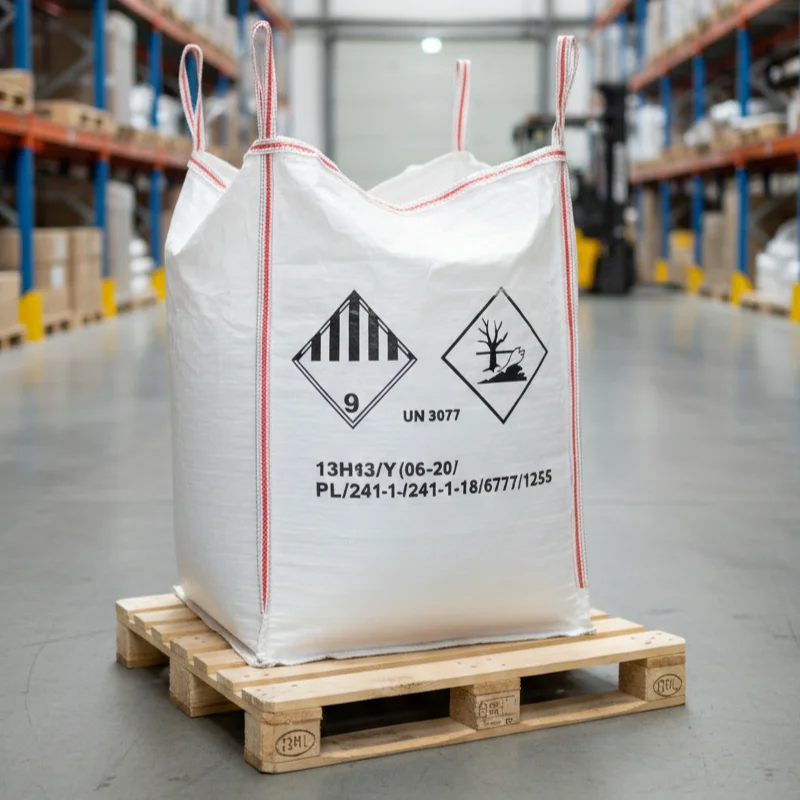
UN bags are special type of FIBCs that are used for transportation of dangerous goods. The UN bags are designed and tested in accordance with the recommendations laid down in the “United Nations Recommendation on the Transportation of Dangerous Goods (Orange Book)”.
The transportation of hazardous goods is regulated worldwide by a team of experts from the United Nations. They have established directives to prevent accidents, injuries and damage to property; protect public health and prevent pollution.
All the UN Certified FIBC must have UN mark on them. The appearance of this mark is described in the Orange Book. The marking has to be durable, legible and readily visible. Letters, symbols and numbers shall be at least 12 mm high.
UN FIBC
The Ultimate Guide to UN Certified FIBC Bags
UN Certified FIBCs are the heavyweights of safety in the bulk packaging world. They are not just bags; they are certified hazardous goods containers. Designed and tested rigorously to meet the United Nations Recommendations on the Transport of Dangerous Goods (the 'Orange Book'), these bags are legally required for transporting hazardous materials.
Unlike standard FIBCs where a safety factor is calculated, UN bags must physically pass punishing tests: 1.8m drop tests, topple tests, tear propagation tests, and stacking tests. Only after surviving these brutal tests without leaking is a specific design granted a UN code. This code is permanently printed on the bag, telling regulators exactly what that bag is capable of handling.
Using a UN bag is about compliance and liability. Whether you are moving chemical waste, mining explosives, or environmental clean-up materials, the UN bag ensures that the contents stay contained, even in the event of rough handling or accidents during transport.
Commercial Uses
Environmental services uses these for cleaning up oil spills or contaminated soil (remediation). The secure containment ensures pollutants don't leak back into the environment during disposal.
The mining industry relies on UN bags for transporting explosive precursors (like ammonium nitrate) and concentrates that may be toxic or ecologically damaging.
Chemical manufacturers use them for Class 4, 5, and 9 hazardous goods, ensuring compliance with international maritime (IMDG) and road (ADR) transport regulations.
Advantages
- Certified for Dangerous Goods
- Rigorous safety testing (Drop, Tear, Stack)
- Compliant with UN 'Orange Book' standards
- Ensures safety public and environmental safety
Applications
- Hazardous waste
- Dangerous chemicals
- Mining & Explosives
- Regulated pharmaceutical waste
UN FIBC sub-types
Designation and type of bag
| SN | UN No. | Type of bag |
|---|---|---|
| 01 | 13H1 | FIBCs made out of uncoated fabric and without liner. |
| 02 | 13H2 | FIBCs made out of coated fabric and without liner. |
| 03 | 13H3 | FIBCs made out of uncoated fabric and with liner. |
| 04 | 13H4 | FIBCs made out of coated fabric and with liner. |
Packing groups
Degree of danger and test requirements
| SN | Degree of danger | Drop test | Packing group | UN symbol | Max volume |
|---|---|---|---|---|---|
| 1 | High | 1.8 Mtrs. | I | X | 1.5 m3 |
| 2 | Medium | 1.2 Mtrs. | II | Y | 3 m3 |
| 3 | Low | 0.8 Mtrs. | III | Z | 3 m3 |
UN certification tests
Tests performed for UN certification
Top lift test
The FIBC is loaded with six times the maximum load.
Drop test
Depending on the packaging group, the FIBC filled with the maximum load is dropped in an upright position from a height of 80 cm or 120 cm.
Topple test
Depending on the packaging group, the FIBC filled with the maximum load is toppled from a height of 80 cm or 120 cm.
Righting test
After being toppled, the FIBC filled with the maximum load is lifted to an upright position on one or two loops.
Tear test
A 100 mm tear is made on one of the sides of the FIBC filled with the maximum load. The FIBC is then filled with twice its maximum load for a minimum of five minutes. Finally, the FIBC is suspended with its SWL for another five minutes.
Stacking test
The FIBC filled with the maximum load is loaded with 1.8 times the weight that is permitted on top of the FIBC.